Explainers & Tutorials
Explanations, numerical examples, and code for exploring ocean dynamics and data analysis.
Explainers
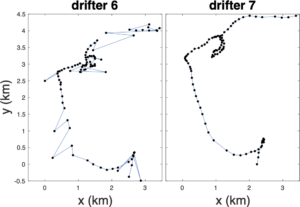
Smoothing noisy GPS data
How smoothing splines handle noisy drifter positions, outliers, and interpolation.
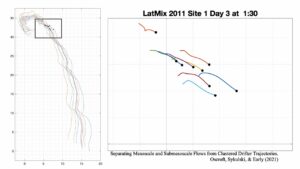
Separating flows from drifter trajectories
Using clusters of drifting instruments to distinguish mesoscale flow from smaller-scale dispersion.
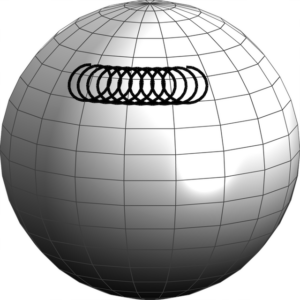
Inertial oscillations
The motion of a particle on a rotating Earth, with exact solutions and MATLAB code.
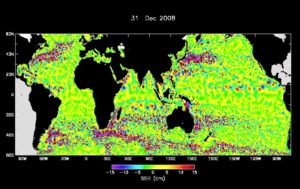
Quasigeostrophic eddies
Satellite observations and numerical experiments exploring eddy propagation and fluid transport.
Numerical examples
The numerical models below demonstrate how GLNumericalModelingKit can be used to solve partial differential equations. All of the examples are open source and available for download.
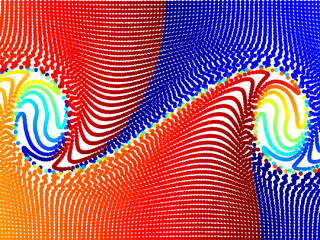
Kelvin Helmholtz Instability
This models an unstable shear flow. The model is initialized with a strong shear, then is given a small perturbation, resulting in the flow going unstable and the creation of Kelvin-Helmholtz billows. The code outputs the fluid velocity, vorticity and particle trajectories.
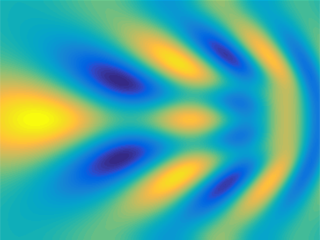
Rossby Waves
This models the two-dimensional linearized quasigeostrophic potential vorticity equation. The model is initialized with a Gaussian shaped eddy, which quickly disperses into Rossby waves.
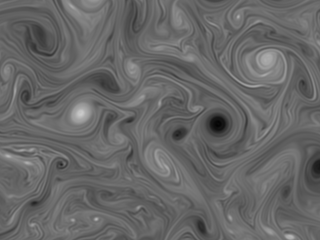
Turbulence Spin Up
This models the forced-dissipative quasigeostrophic potential vorticity equation as it spins up with a constant forcing.
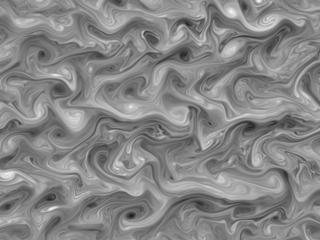
Anisotropic Turbulence
This models the forced-dissipative quasigeostrophic potential vorticity equation on a beta-plane, which, in comparison to the isotropic example above, shows directional dependence in the fluid flow.
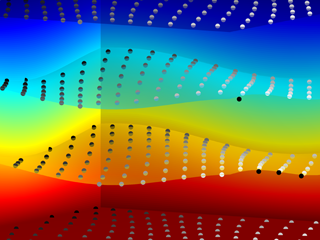
Internal Waves
This model advects particles using the analytical solution to the three-dimensional linearized internal wave equation for arbitrary stratification. In the two cases shown here, the model is initialized with a single internal mode and the full Garrett-Munk spectrum.
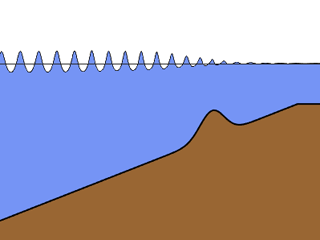
Shoaling surface gravity waves
This models surface gravity waves they approach a sandbar. Waves are generated in the deep water on the left of the domain, then propagate towards a shallowing continental slope, before impinging upon a sandbar.